
RAMS ResidencyCAS Information




.png?sfvrsn=9550fbe4_0 "ACOEP RSO Logo")
The ResidencyCAS Infographics, created through a collaborative effort by AEROS member organizations: SAEM RAMS, CORD, EMRA, AAEM/RSA, and ACOEP RSO, were designed to give medical students and residency applicants a clear, accessible overview of the ResidencyCAS process and updates in Emergency Medicine residency applications. This set of visuals highlight key information to help you navigate the new system confidently.
What You’ll Find:
Application Timeline
Pricing Overview
100% Participation by EM Programs
Geographic Connections & Signals
SLOEs (Standardized Letters of Evaluation)
Timeline for ResidencyCAS
Timeline for ResidencyCAS
Important dates for Emergency Medicine residency applicants
June 4, 2025 - ResidencyCAS is open


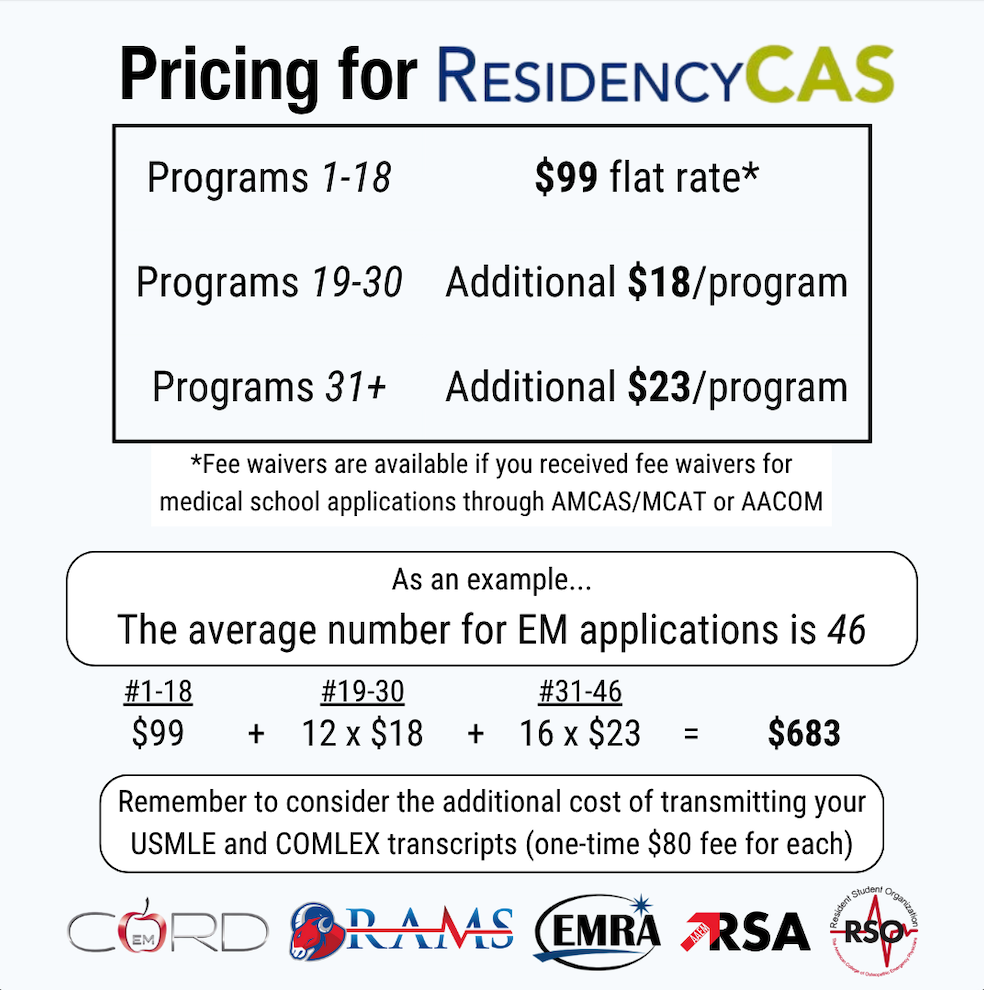
Pricing for ResidencyCAS
Pricing for ResidencyCAS
| Programs 1-18 | $99 flat rate |
| Programs 19-30 | Additional $18/program |
| Programs 31+ | Additional $23/program |
Fee waivers are available if you received fee waivers for medical school applications through AMCAS/MCAT or AACOM
As an example, the average number for EM applications is 46.
| #1-18 | #19-30 | #31-46 | ||||
| $99 | + | 12 x $18 | + | 16 x $23 | = | $683 |
Remember to consider the additional cost of transmitting your USMLE and COMLEX transcripts (one-time $80 fee for each)
Geographic Connections
Geographic Connections
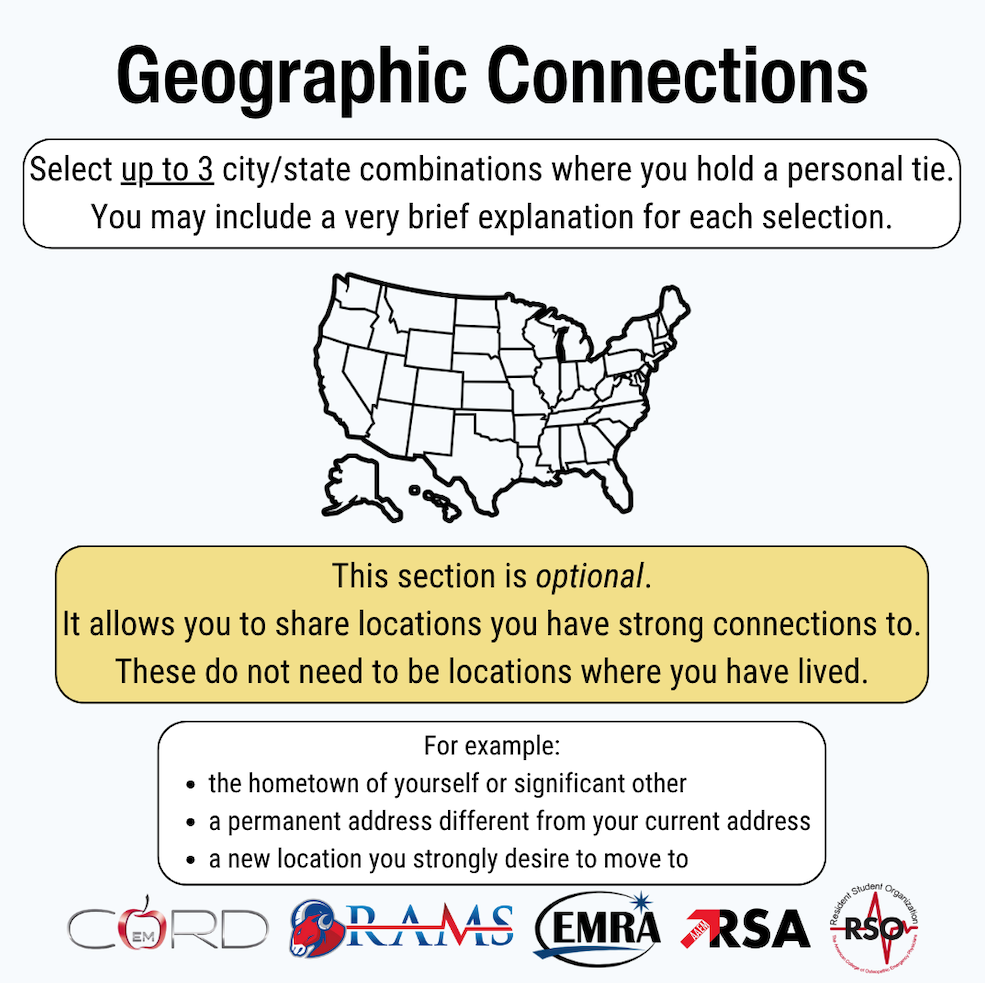
Select up to 3 city/state combinations where you hold a personal tie. You may include a very brief explanation for each selection.
This section is optional. It allows you to share locations you have strong connections to. These do not need to be locations where you have lived. For example:
- the hometown of yourself or significant other
- a permanent address different from your current address
- a new location you strongly desire to move to
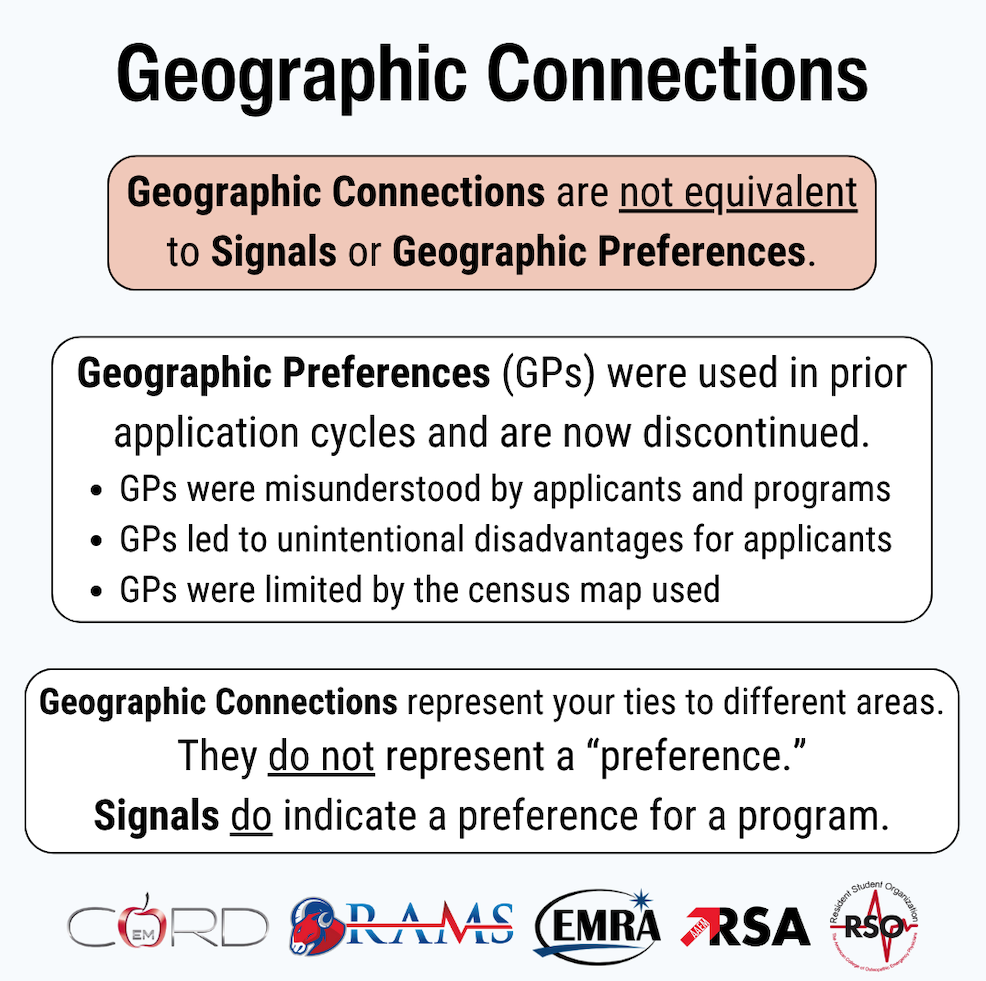
Geographic Connections are not equivalent to Signals or Geographic Preferences (GPs). GPs were used in prior application cycles and are now discontinued.
- GPs were misunderstood by applicants and programs1
- GPs led to unintentional disadvantages for applicants1
- GPs were limited by the census map used1
Geographic Connections represent your ties to different areas. They do not represent a “preference.” Signals do indicate a preference for a program.
Signals
Signals
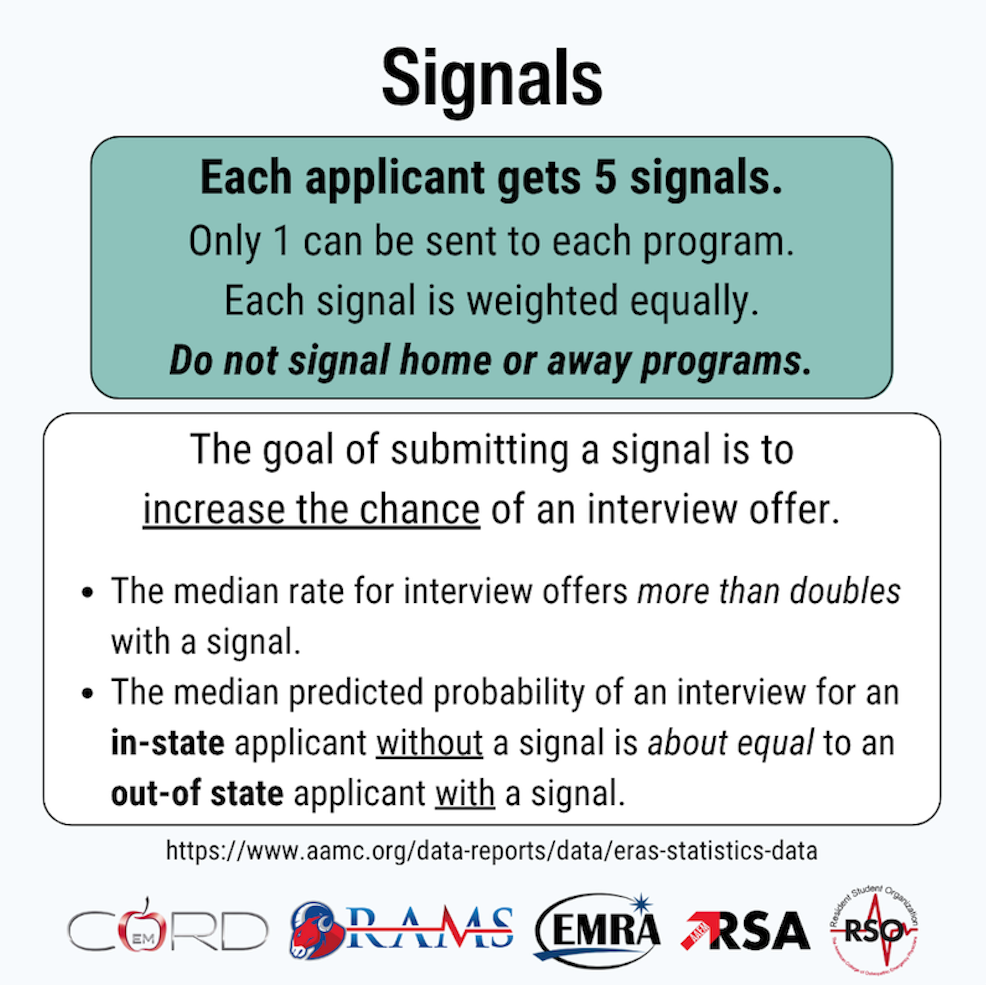
Each applicant gets 5 signals. Only 1 can be sent to each program. Each signal is weighted equally. Do not signal home or away programs.
The goal of submitting a signal is to increase the chance of an interview offer.
- The median rate for interview offers more than doubles with a signal.2
- The median predicted probability of an interview for an in-state applicant without a signal is about equal to an out-of state applicant with a signal.2
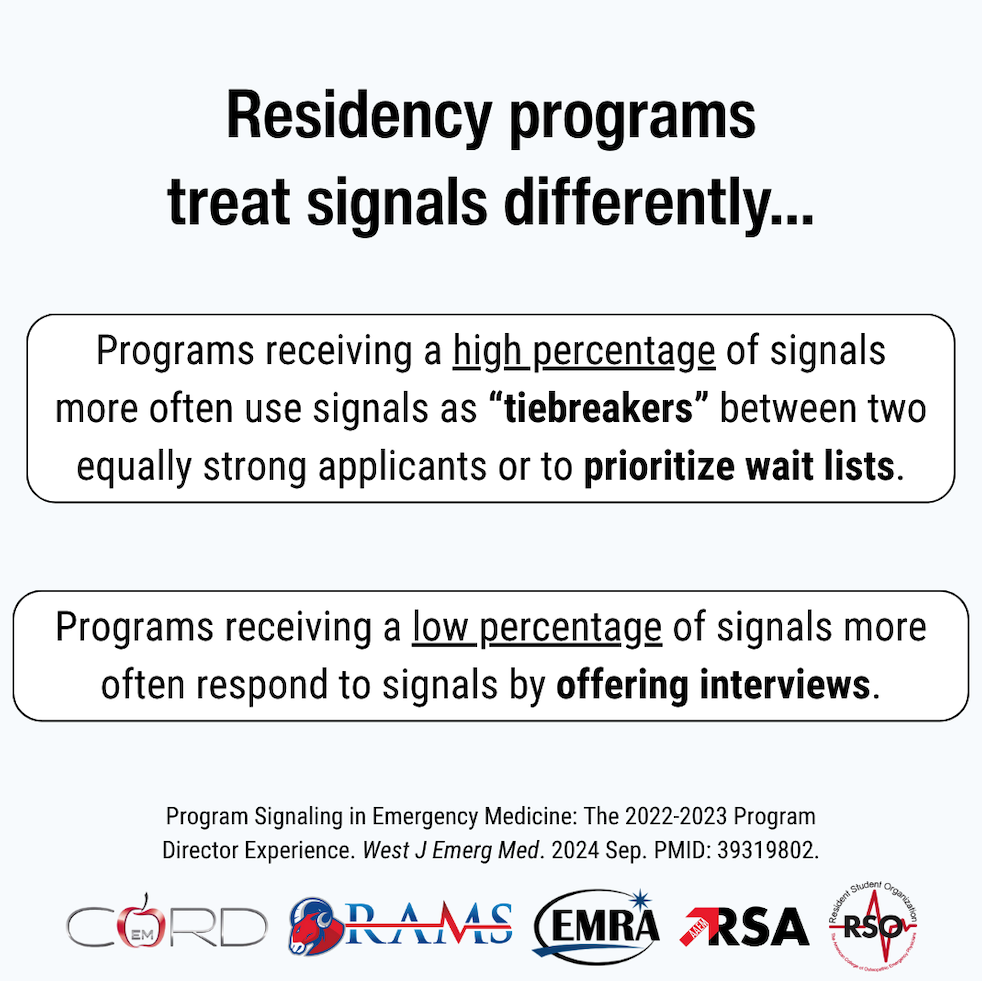
Residency programs treat signals differently
- Programs receiving a high percentage of signals more often use signals as “tiebreakers” between two equally strong applicants or to prioritize wait lists.3
- Programs receiving a low percentage of signals more often respond to signals by offering interviews.3
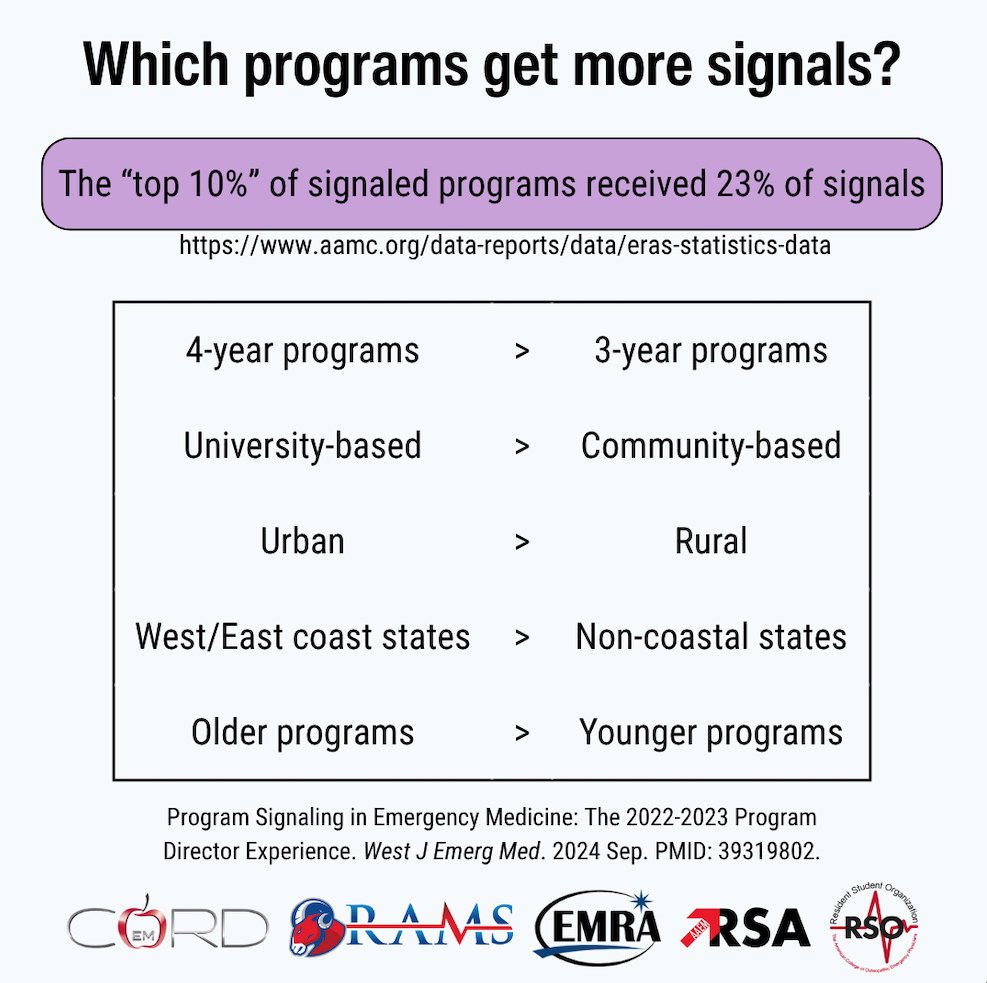
Which programs get more signals?
The “top 10%” of signaled programs received 23% of signals2
| 4-year programs | > | 3-year programs3 | |
| University-based | > | Community-based3 | |
| Urban | > | Rural3 | |
| West/East coast states | > | Non-coastal states3 | |
| Older programs | > | Younger programs3 |
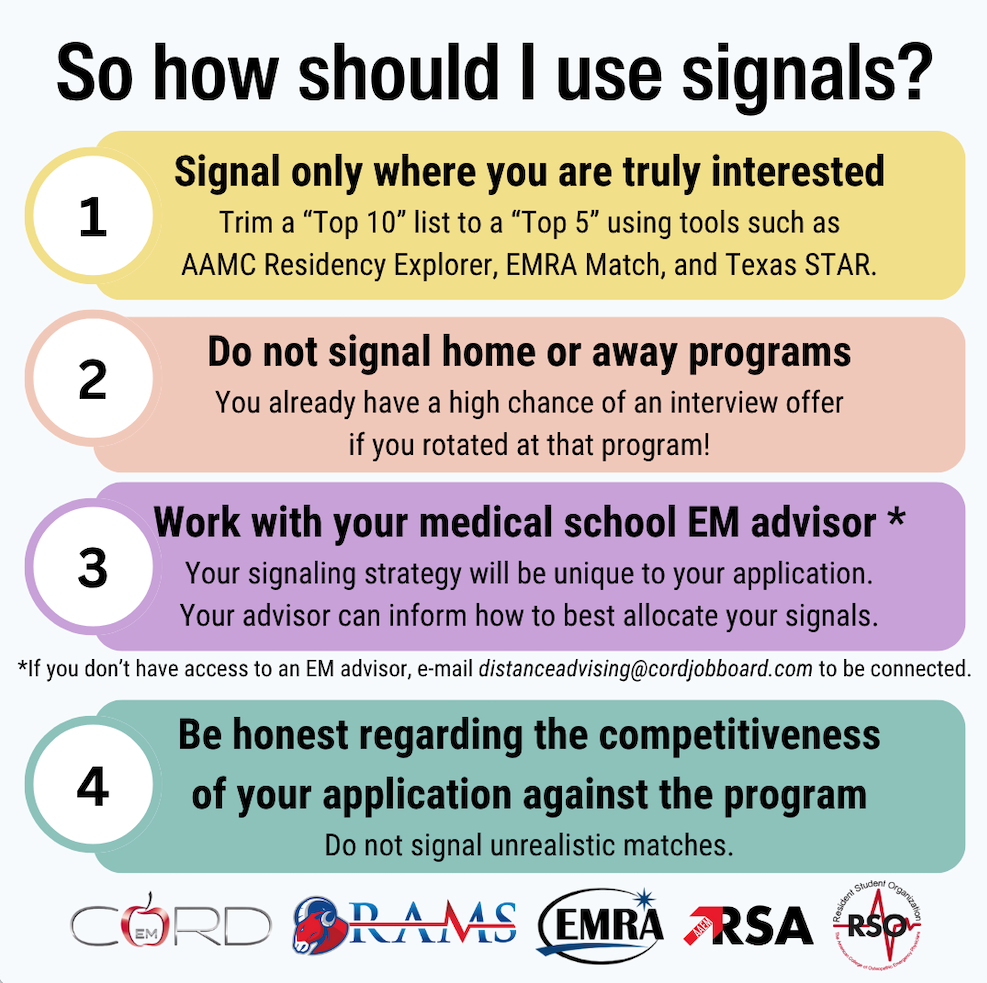
So how should I use signals?
- Signal only where you are truly interested.
- Trim a “Top 10” list to a “Top 5” using tools such as AAMC Residency Explorer, EMRA Match, and Texas STAR.
- Do not signal home or away programs
- You already have a high chance of an interview offer if you rotated at that program!
- Work with your medical school EM advisor.
- Your signaling strategy will be unique to your application.
- Your advisor can inform how to best allocate your signals.
- If you don’t have access to an EM advisor, e-mail distanceadvising@cordjobboard.com to be connected.
- Be honest regarding the competitiveness of your application against the program.
- Do not signal unrealistic matches.
2Association of American Medical Colleges. ERAS® statistics: 2025 data and reports. AAMC. https://www.aamc.org/data-reports/data/eras-statistics-data
3Pelletier‑Bui AE, Fallon T, Smith L, et al. Program Signaling in Emergency Medicine: The 2022-2023 Program Director Experience. West J Emerg Med. 2024 Sep. PMID: 39319802.
SLOEs
SLOEs
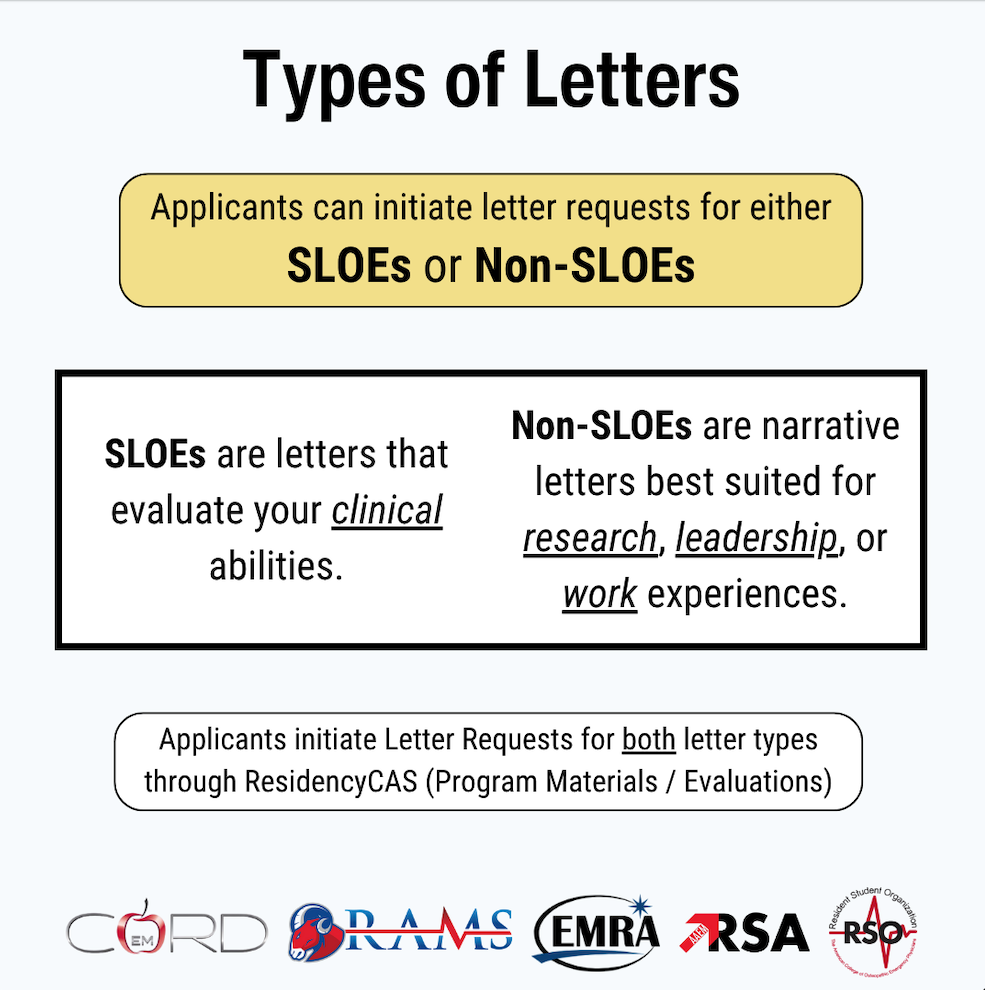
Types of Letters
- SLOEs are letters that evaluate your clinical abilities.
- Non-SLOEs are narrative letters best suited for research, leadership, or work experiences.
Types of SLOEs
| eSLOE | Obtained after rotating at an EM residency program (either home or away) |
| Non-residency based SLOE | Evaluation by EM faculty not at an EM program (weighed less than eSLOEs) |
| (O)SLOE | Evaluation on an off-service rotation outside of EM |
| Sub-specialty SLOE | Rotation teaching EM sub-specialty content (e.g. ultrasound, pediatrics, toxicology) |
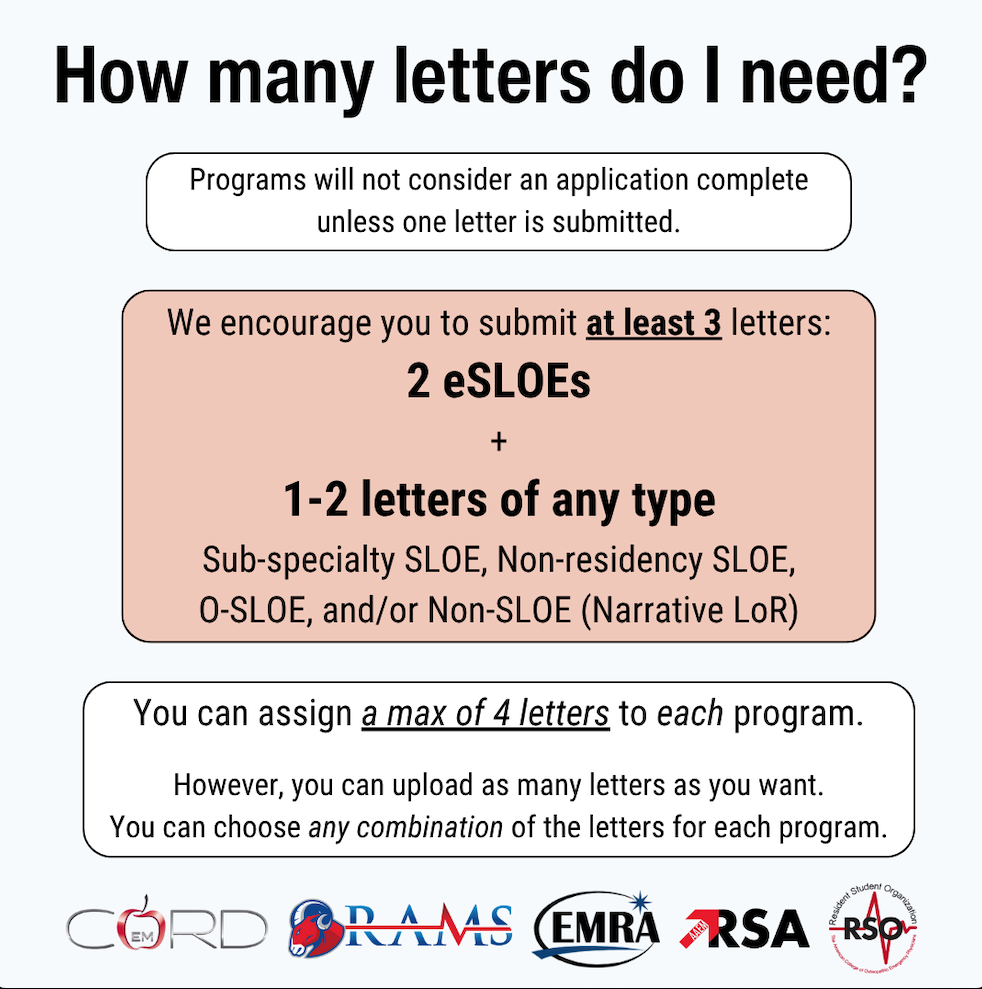
How many letters do I need?
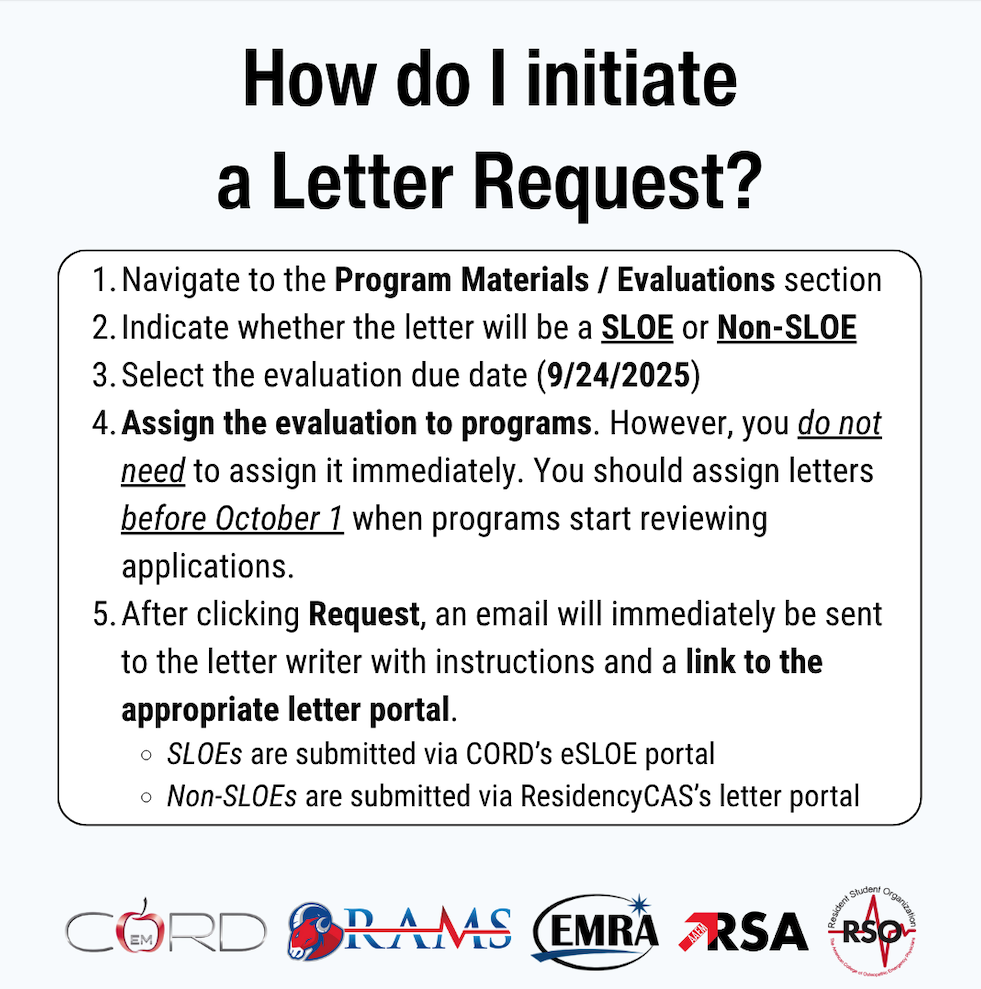
How do I initiate a Letter Request?
- Navigate to the Program Materials / Evaluations section
- Indicate whether the letter will be a SLOE or Non-SLOE
- Select the evaluation due date (9/24/2025)
- Assign the evaluation to programs. However, you do not need to assign it immediately.
- You should assign letters before October 1 when programs start reviewing applications.
- After clicking Request, an email will immediately be sent to the letter writer with instructions and a link to the appropriate letter portal.
- SLOEs are submitted via CORD’s eSLOE portal
- Non-SLOEs are submitted via ResidencyCAS’s letter portal
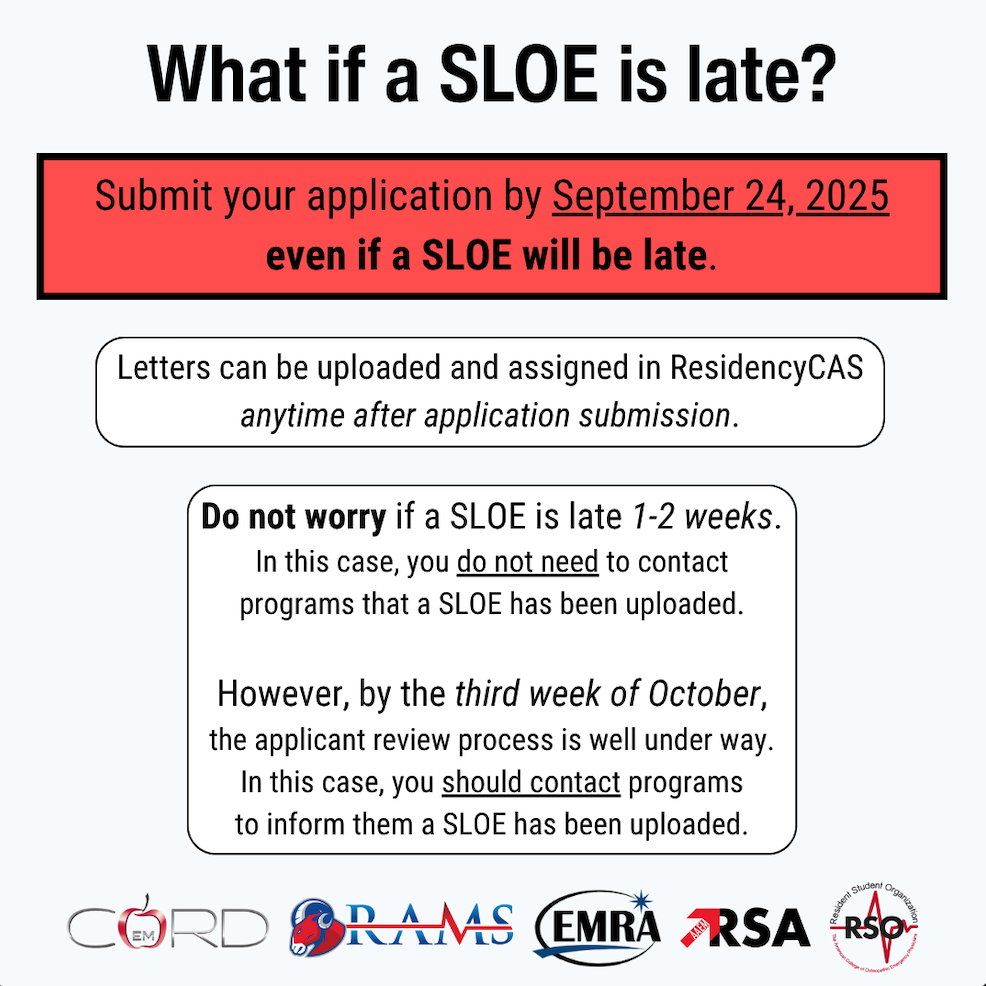
What if a SLOE is late?


Additional Resources:
- EMRA & CORD Student Advising Guide chapter on ResidencyCAS
- 2025 Application Process and Recent Changes for Medical Students
- CORD ResidencyCAS Webinar- "Succeeding in ResidencyCAS Interviews" (September 2025)